
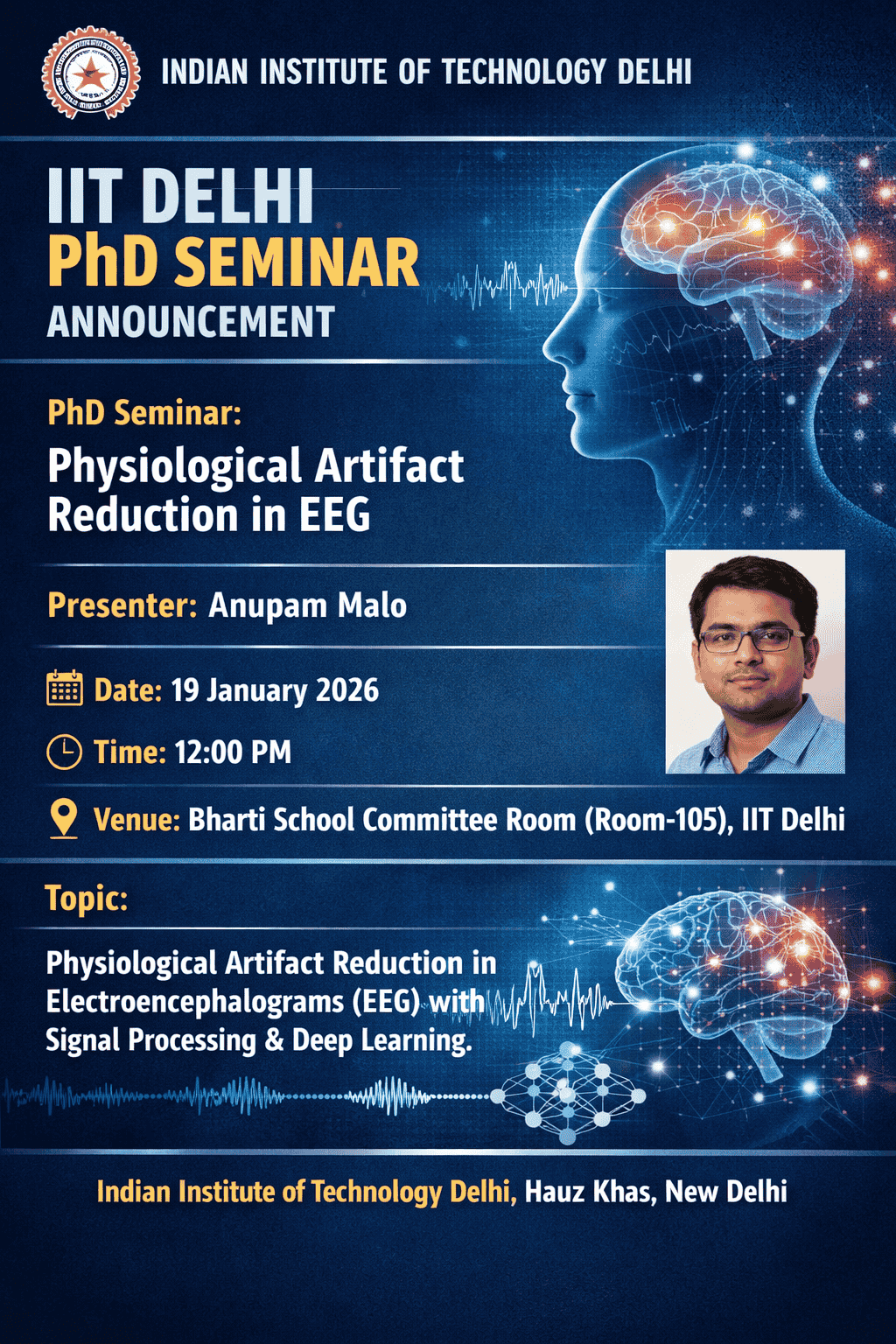
Physiological Artifact Reduction in Electroencephalograms (EEG) with Signal Processing and Deep Learning
Presenter: Anupam Malo (Entry No: 2017BSZ8500), PhD Scholar
Department: DBS-T (likely Doctoral Programme in Biological Sciences & Technology), Indian Institute of Technology (IIT) Delhi
Date & Time: January 19, 2026 | 12:00 PM
Venue: Bharti School Committee Room (Room-105), IIT Delhi
Internal Supervisors:
Tapan Kumar Gandhi
Bijaya Ketan Panigrahi
About the Seminar:
This is an academic PhD research seminar presented by a doctoral scholar at IIT Delhi as part of the seminar requirements for the PhD programme.
The seminar topic focuses on reducing physiological artifacts in EEG (Electroencephalogram) recordings using advanced signal processing methods and deep learning techniques.
EEG is a non-invasive method for recording electrical activity of the brain through electrodes placed on the scalp. It is widely used in neuroscience research, clinical diagnosis, and brain-computer interfaces, but raw EEG signals are often contaminated by physiological artifacts such as muscle activity, eye blinks, and heart signals.
The seminar likely explores:
Sources of physiological artifacts in EEG recordings and their impact on data quality and analysis.
Signal processing approaches to detect and filter out artifact components from EEG signals, improving clarity and interpretability.
Deep learning models applied to automatically identify and remove artifact patterns from EEG data, potentially outperforming traditional methods.
Comparisons between classical artifact correction techniques and machine learning-based methods in terms of accuracy and efficiency.
This work is relevant to applications in neuroscience research, clinical EEG analysis, brain–computer interfacing (BCI), and other domains where high-quality EEG data is critical for interpreting brain function or building reliable systems.


© 2026 PhD Coaching Classes, Delhi. | All rights reserved.